
Project Summary
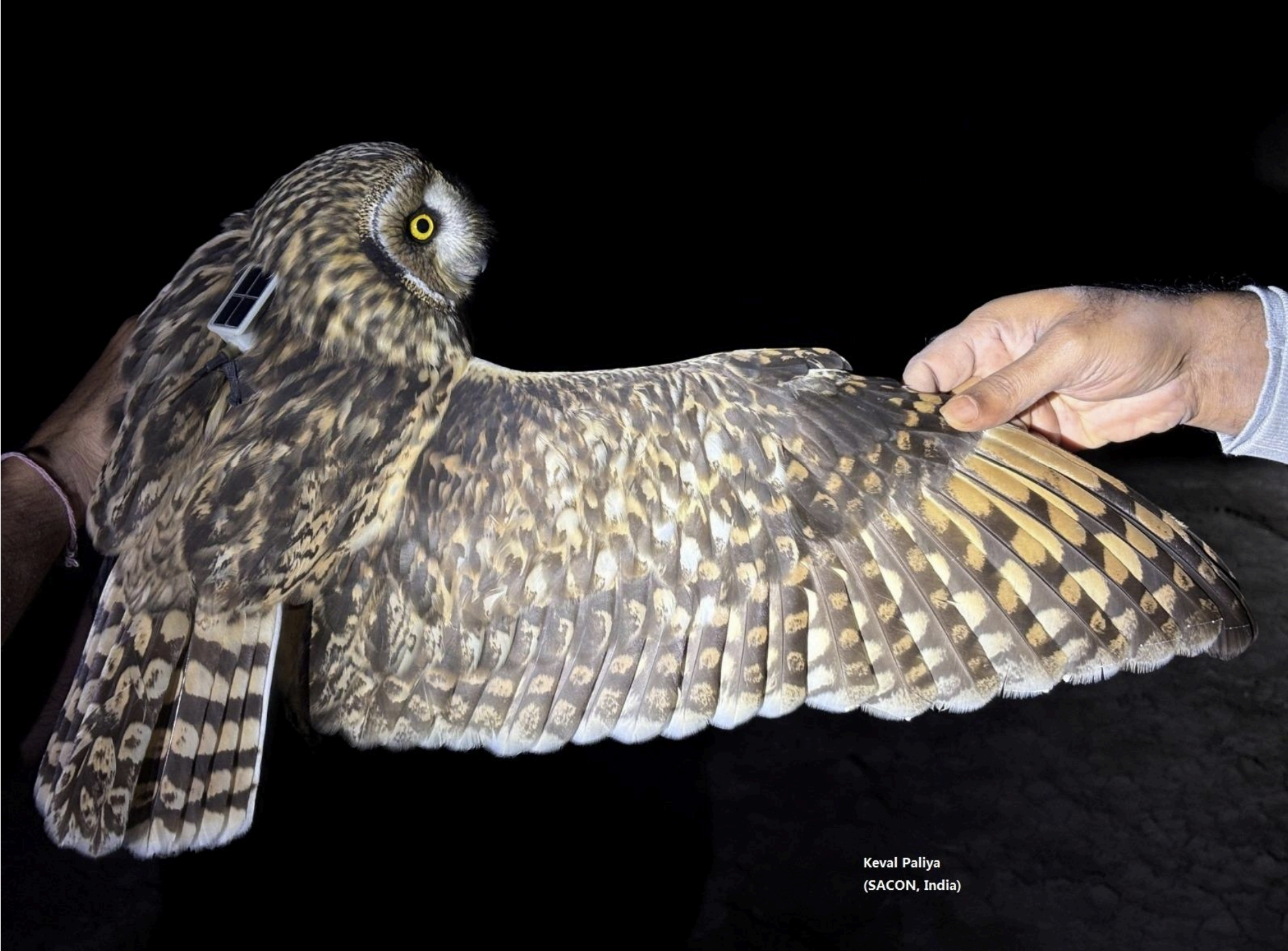
Raptors inhabiting Open Natural Ecosystems exhibit the steepest population declines among all avian guilds, as documented in the State of Indian Birds 2023 report. Despite supporting substantial raptor assemblages, these ecosystems are threatened and are systematically misclassified as “wastelands” in land-use planning frameworks, leading to habitat degradation and fragmentation. To quantify the ecological consequences of land use and land cover change on raptor populations, we propose employing the Short-eared Owl (Asio flammeus) as a model species to monitor the impact of grassland fragmentation on the species habitat use through its movement patterns from telemetry data.
This Palearctic migrant utilizes Indian grasslands as non-breeding habitat, making it an ideal indicator of grassland ecosystem health. We will deploy GPS-GSM transmitters on 15 individuals in the grasslands of Gujarat, over one complete annual cycles (12 months). Spatial data will be analyzed using Resource Selection Functions (RSF) to quantify habitat selection at multiple spatial scales. Home range dynamics will be assessed through kernel density estimation (KDE), enabling examination of habitat-specific influences on space-use patterns. Movement ecology analyses will identify critical stopover sites along the Central Asian Flyway and elucidate migratory phenology and route fidelity. This investigation will yield crucial insights into Short-eared Owl ecology while simultaneously delineating priority grassland habitats for conservation intervention. The findings will inform evidence-based policy recommendations for the protection of Open Natural Ecosystems and associated raptor populations.
Project Gallery


Project Updates
August 4, 2026
Tagging was initially planned in the Banni Grasslands of Kutch, Gujarat. However, field surveys revealed that the primary congregation of Short-eared Owls was occurring in the Little Rann of Kutch (LRK), which was subsequently identified as the key wintering site in India, with possibly the highest recorded congregation of this species in the country. Based on field findings, the updated study area now encompasses: Little Rann of Kutch (Primary stopover/wintering site), Banni Grasslands (Secondary wintering site), Velavadar National Park, Nal Sarovar Bird Sanctuary, Khijadiya Bird Sanctuary, Mokar Sagar Wetlands and Dahej Outskirts – Included in revised permit. Two of the three tagged Short-eared Owls continue to transmit reliably and remain active, providing a steady stream of high-resolution movement
data.
Interesting findings / milestones
- First GPS-telemetry study of Short-eared Owls in India, revealing their migration ecology across the Central Asian Flyway.
- Little Rann of Kachchh appears to be one of the most important wintering sites for
Short-eared Owls in India and may support one of the country’s largest known winter
congregations. Banni Grasslands, Bhal region, Nal Sarovar and other grasslands serve
as a secondary wintering habitat with sightings increasing from January onwards,
indicating a staggered arrival pattern. - Documented long-distance migrations ranging from 2,179 km to 4,623 km.
- All tagged owls crossed Pamir mountain ranges, reaching altitudes above 4,300 m, with a maximum recorded altitude of 4,884 m.
- Demonstrated the species’ remarkable ability to undertake high-altitude, long-distance migrations, despite being primarily associated with lowland grasslands, agricultural landscapes and wetlands.
- Provided the first direct evidence of migratory connectivity between the grasslands and
saline wetlands of western India and breeding areas in Central Asia - Identified critical migration routes, high-altitude crossings, and important stopover sites, providing essential information for future conservation planning.
- Highlighted the Banni Grasslands and Little Rann of Kutch as internationally important wintering habitats within the Central Asian Flyway.
- Established a scientific foundation for the conservation of migratory grassland raptors and the protection of India’s open natural ecosystems.
- Experienced an extreme climatic transition from approximately 41°C in the Little Rann of Kutch to around −3°C while crossing the Pamir Mountains, demonstrating that the tracked owls experienced an extreme climatic transition during migration
Challenges
Movement ecology is a rapidly advancing field, transforming our understanding of how animals move, survive, and respond to changing environments. Modern tracking technologies, such as lightweight GPS-GSM transmitters, now allow researchers to follow birds across thousands of kilometres with remarkable precision. However, these technological advances come at a considerable cost. The transmitters are expensive, and securing funding for such research remains a major challenge, particularly in countries like India, where conservation science must compete with many other pressing priorities.
Yet, studies like these are essential. Science-based conservation depends on understanding how species use landscapes, where they migrate, and the threats they face throughout their annual cycle. Without this knowledge, effective conservation planning is little more than guesswork. Our work represents the first study to investigate the movement ecology of the Short-eared Owl across the Central Asian Flyway.
The story is far from over. We have already followed these remarkable owls on their incredible journey to their breeding grounds, travelling thousands of kilometres across international borders. Now, we eagerly await their return migration, hoping to reveal the next chapter of their lives.
Leave a Reply